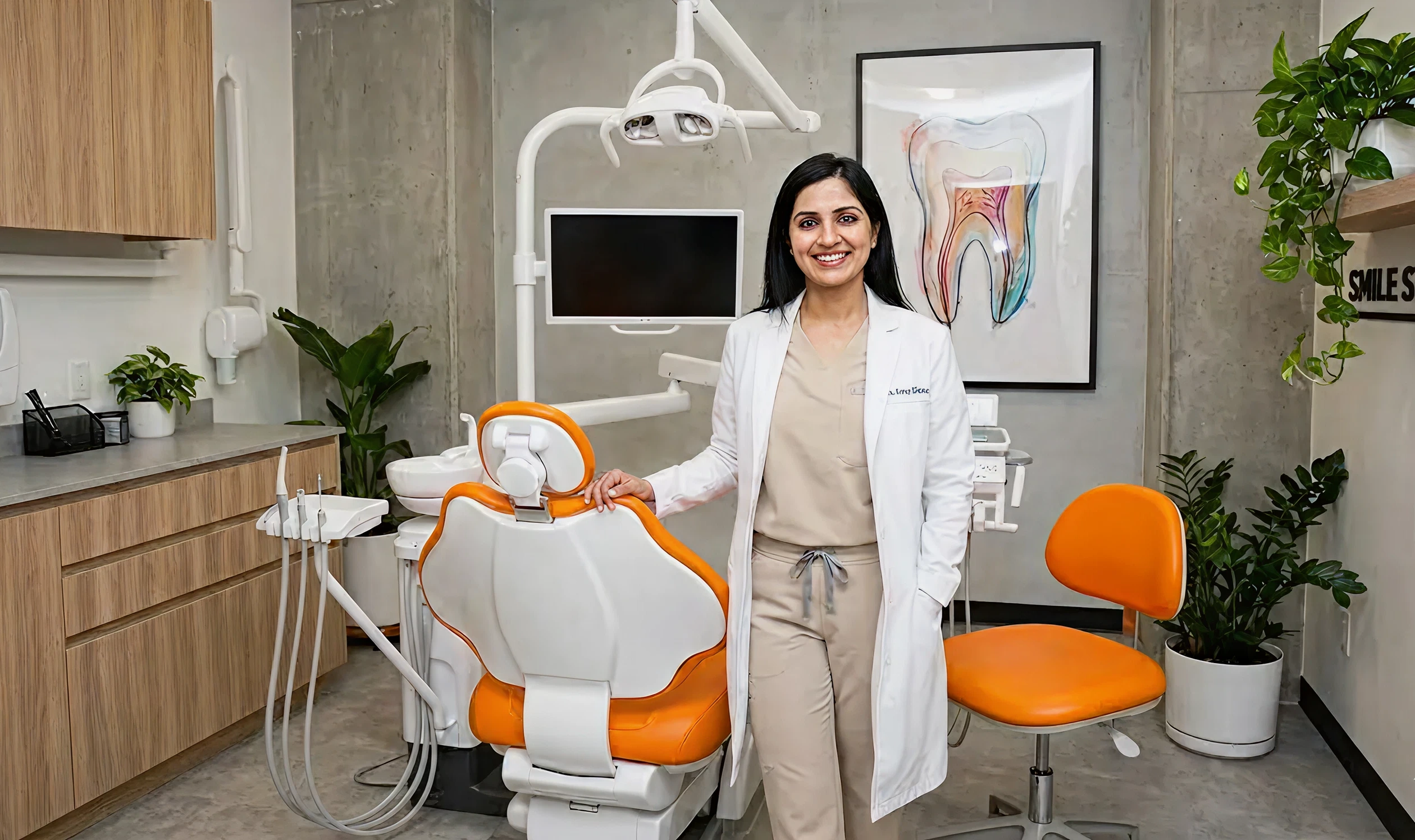
Your Implantologist in India checks key factors to plan a predictable, long-lasting implant outcome.
DISCLAIMER: Please note that the prices mentioned on this page: (a) present a range (depending upon the severity of the dental condition, the technology used in treatment, type of dental products used, etc.); (b) are true as on the date of this page and may change on a later date, in accordance with the standard company policy; (c) may be subject to standard aberrations or generalizations on account of the use of AI in general Google/internet search by you.
{
"@context": "https://schema.org",
"@type": "FAQPage",
"mainEntity": [
{
"@type": "Question",
"name": "What is an implantologist and what qualifications make someone one?",
"acceptedAnswer": {
"@type": "Answer",
"text": "An implantologist is a dentist with advanced specialist training in the surgical placement and prosthetic restoration of dental implants. At Clove Dental, implantologists hold MDS qualifications in Oral Surgery, Prosthodontics, or Periodontics supplemented by dedicated implant surgery certification and clinical fellowship training. Over 73% of Clove Dental's 1,500+ dentists are MDS postgraduates, making specialist-led implant care accessible across the 715+ clinic network."
}
},
{
"@type": "Question",
"name": "How is an implantologist different from a general dentist offering implants?",
"acceptedAnswer": {
"@type": "Answer",
"text": "Implant placement is a surgical procedure with anatomical risk, the inferior alveolar nerve, sinuses, and adjacent roots require precise avoidance. An implantologist's specialist surgical training, CBCT-guided planning experience, and higher procedural volume reduce the risk of complications, optimise implant positioning, and improve long-term outcomes compared to occasional implant placement by a general dentist. For complex cases, specialist involvement is not optional."
}
},
{
"@type": "Question",
"name": "Why is CBCT 3D imaging non-negotiable before implant placement?",
"acceptedAnswer": {
"@type": "Answer",
"text": "A conventional 2D dental X-ray shows mesiodistal anatomy but not the buccolingual bone width, sinus proximity, or exact nerve canal position. CBCT produces a three-dimensional map of the jawbone, enabling virtual implant planning that determines the precise position, angle, length, and diameter of the implant before surgery. At Clove Dental, CBCT-guided planning is a clinical standard, not an optional upgrade, for every implant case."
}
},
{
"@type": "Question",
"name": "When is bone grafting required before implant placement?",
"acceptedAnswer": {
"@type": "Answer",
"text": "Bone grafting is needed when the jaw lacks sufficient volume to safely anchor an implant, a situation that develops progressively after tooth loss. CBCT imaging quantifies the exact bone deficit. Grafting options include synthetic hydroxyapatite, bovine-derived xenograft (Bio-Oss), or autogenous bone from another site. Clove Dental's implantologists recommend grafting only when imaging confirms the clinical necessity, it is never added as a routine procedure."
}
},
{
"@type": "Question",
"name": "What is All-on-4 implant treatment and who is it suitable for?",
"acceptedAnswer": {
"@type": "Answer",
"text": "All-on-4 is a full-arch rehabilitation technique using four implants, two axial and two angled posteriorly, to support a complete fixed prosthetic arch. The angled posterior implants avoid the need for sinus lifting in the upper jaw and maximise contact with available anterior bone. It is designed for patients with complete or near-complete tooth loss seeking fixed, non-removable teeth as an alternative to conventional dentures."
}
},
{
"@type": "Question",
"name": "What implant success rate should a patient expect?",
"acceptedAnswer": {
"@type": "Answer",
"text": "At 10 years, dental implants placed by adequately trained clinicians using quality systems achieve 95%+ success rates globally. At Clove Dental, with 35,000+ successful implant placements, standardised surgical protocols, quality international implant systems, and post-operative monitoring, outcomes are consistently aligned with this benchmark. Patient factors most strongly associated with failure are heavy smoking and uncontrolled systemic disease."
}
},
{
"@type": "Question",
"name": "How long do dental implants last, is the investment justified?",
"acceptedAnswer": {
"@type": "Answer",
"text": "The titanium fixture, once osseointegrated, is permanent for most patients, outlasting bridges and dentures by decades. The ceramic crown may need replacement after 15–20 years. Amortised over a lifetime, the per-year cost of an implant is lower than repeated bridge or denture replacement cycles, and the biological advantage of bone preservation makes it the only tooth replacement option that does not generate progressively worsening jaw anatomy over time."
}
},
{
"@type": "Question",
"name": "What does implant treatment cost at Clove Dental?",
"acceptedAnswer": {
"@type": "Answer",
"text": "A single implant, fixture, abutment, and zirconia crown, costs approximately ₹25,000–₹70,000. Bone grafting, where needed, adds ₹8,000–₹25,000. Full-arch All-on-4 rehabilitation is quoted as a comprehensive case after CBCT assessment and prosthodontic planning. Every cost is itemised and presented in writing before any surgical commitment. Clove Dental's transparent pricing policy applies uniformly across all 715+ clinics."
}
}
]
}